Lost in Translation? Why Not Understanding Japanese Actually Makes Shiodome Shows Better
Photo: Charles O'Rear, Public domain, via Wikimedia Commons
Let me guess how this conversation goes.
You tell someone you're planning to catch live theater or a concert in Tokyo, and they immediately ask the question: But do you speak Japanese? And when you say no, there's this slight wince. A well-meaning concern. Maybe a gentle suggestion that you stick to things with English subtitles, or that you focus on the international headliners where the language barrier is less of an issue.
Here's what I want to tell you, and what I genuinely believe after spending time watching American visitors discover Shiodome's entertainment scene for the first time: that concern is almost entirely wrong. Not partially wrong. Almost entirely wrong.
Not understanding Japanese doesn't diminish your experience at a Shiodome performance. In a surprising number of cases, it actively improves it.
I know that sounds like a travel writer trying to put a positive spin on an inconvenience. Stick with me.
The Assumption Worth Questioning
The worry about language barriers in entertainment is built on a pretty specific assumption: that performance is primarily a verbal medium, and that meaning flows through words. If you can't decode the words, you miss the meaning. Simple.
Except that assumption is wrong even in your native language. Think about the last concert you attended in English. How much of what moved you was the literal lyrical content versus the sound, the energy, the physical presence of a performer working a room? Think about the last piece of physical comedy that made you genuinely laugh — how much of that was words?
Now multiply that by the particular strengths of Japanese live performance culture, which has historically leaned hard into the non-verbal: movement, visual spectacle, musical precision, comedic physicality. Shiodome's entertainment calendar is full of shows where dialogue, even if you could understand every word, would be maybe 30% of what's actually happening.
When you can't follow the words, you stop trying to follow the words. And that's when you start actually watching.
What Happens to Your Attention When Language Falls Away
There's a particular kind of hyperawareness that kicks in when you're watching a performance in a language you don't speak. Your brain, deprived of its usual shortcut (just listen to what they're saying), starts working differently. You read faces more carefully. You notice gesture and posture in ways you normally wouldn't. You track the relationship between performers — who defers to whom, where the tension is, when something shifts.
Several American visitors to Shiodome have described this experience in almost identical terms: they walked into a Japanese theater production skeptical, expecting to feel lost, and walked out feeling like they'd seen more than usual. Not despite the language gap, but because of it.
One visitor from Chicago put it this way: "I couldn't understand the dialogue, but I could completely feel every scene. I was reading the show like a painting instead of like a script. It was exhausting in the best way."
That exhaustion is real, by the way. Active watching is more demanding than passive listening. You'll leave certain Shiodome performances genuinely tired in a way you wouldn't be after a show in English — and the memory of it tends to stick harder as a result.
The Genres Where Language Barely Registers
To be honest, not every performance type is equally accessible without language. A stand-up comedy special built entirely on wordplay is going to be a tougher night than a physical comedy show. A chamber play that's mostly two people talking is going to require more imaginative work than a dance production.
But Shiodome's entertainment offerings skew heavily toward forms where the non-verbal carries most of the weight:
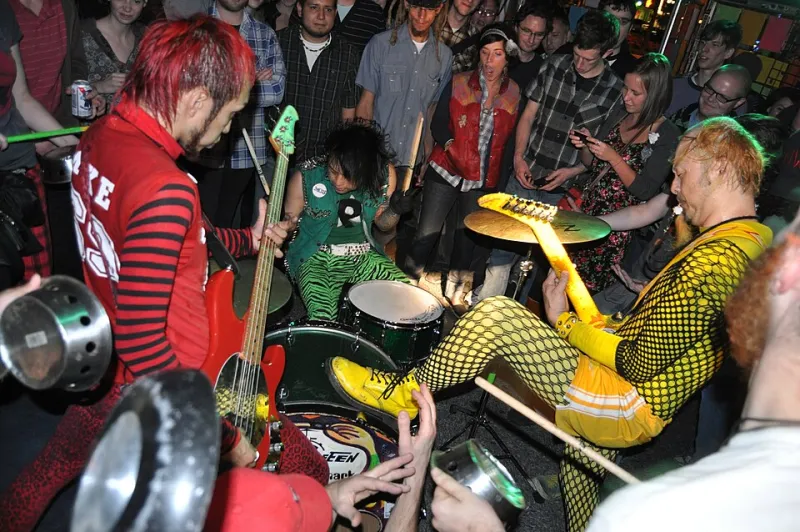
Live music — obvious, but worth stating clearly. Whether it's a J-pop show with 10,000 people or an intimate jazz set with 60, music doesn't need translation. The emotional architecture of a song crosses language completely. Audiences who don't share a single word with a performer still cry at the same moments. This is not a metaphor. It happens constantly.
Rakugo and physical comedy — Rakugo is a traditional Japanese storytelling form where a single performer, seated, conjures multiple characters using only voice, facial expression, and a fan. Yes, the stories are in Japanese. No, you don't need to understand them. The craft of the transformation — watching one person become four distinct people in real time — is mesmerizing regardless of the words.
Dance and movement theater — Shiodome hosts productions that draw on butoh, contemporary dance, and hybrid physical theater forms that are explicitly designed to communicate without language. These aren't accommodations made for foreign audiences. They're the art form itself.
Taiko and traditional music — Percussion-forward traditional music performances are about as close to a universal language as live entertainment gets. The physical impact of a taiko ensemble at full volume doesn't require a single shared word.
A Note From the Other Side of the Stage
Performers in Shiodome are aware of their international audiences. Many of them have thought carefully about what it means to communicate across a language gap — and some find that the presence of visitors who can't fall back on verbal comprehension actually sharpens their performance instincts.
One theater director working in Shiodome's independent scene described it this way: international audience members remind him that his job isn't to deliver information through dialogue. It's to create feeling through every available tool simultaneously. When he sees a non-Japanese speaker in the house, he considers it a useful test of whether the show is actually working.
That perspective reframes the whole situation. You're not a passive receiver struggling to keep up. You're an audience member who's asking the most fundamental question of any performance: does this land without the safety net of shared language? When the answer is yes — and in Shiodome, it often is — the experience carries a different kind of weight.
Practical Ways to Lean Into It
A few things that make the language-gap experience genuinely better rather than just theoretically interesting:
Read the synopsis beforehand. Most major Shiodome productions have some English information available online, and even a rough plot summary gives your brain enough scaffolding to follow emotional arcs without needing line-by-line comprehension. Think of it like knowing the plot of an opera before you go — you're not cheating, you're preparing.
Sit where you can see faces. In smaller venues especially, facial expression carries enormous amounts of information. Positioning matters more when you're reading visually.
Let yourself laugh when the room laughs. Even if you didn't catch the joke, the laughter itself is information. Ride it. You're part of a shared experience, and that shared experience doesn't require you to have heard the same thing.
Don't perform confusion. Some visitors spend their whole time at a Japanese performance looking visibly lost, which is both unnecessary and slightly rude to the performers. Trust your instincts. You understand more than you think.
The Part That Stays With You
There's something that happens when you experience great art in a language you don't speak. The intellectual distance — the fact that you can't over-analyze the words, can't compare the translation to the original, can't get distracted by a clunky line — leaves you unusually open. You're receiving the performance at a more direct level than you're used to.
For a lot of American visitors, Shiodome is the first place they discover this. They come in worried about missing out, and they leave having experienced something that felt, paradoxically, more immediate than performances they've attended in their own language.
The language barrier isn't the obstacle. It's the invitation.
You just have to accept it.