Why American Concert-Goers Are Starting to Ask: 'Why Can't Our Venues Look Like That?'
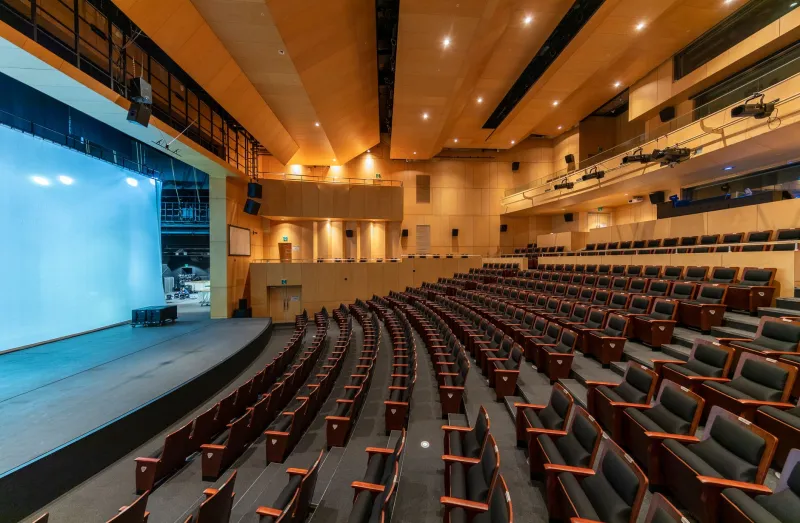
There's a moment that almost every American who attends a live show in Shiodome describes in basically the same way. They walk in, find their seat — sometimes a seat they were genuinely skeptical about when they bought the ticket — and then they just... stop. Because the view is perfect. Not "good for the price" perfect. Not "better than the nosebleeds at Madison Square Garden" perfect. Just perfect.
That moment has a name around here. We call it the Shiodome Effect.
It sounds like marketing language, but it's actually shorthand for something pretty specific: the creeping, uncomfortable realization that everything you've accepted as normal about concert and theater venues back home is, in fact, a choice. A series of choices, made by architects and developers who often prioritized square footage over experience, capacity over comfort, and profit margins over acoustics. Shiodome's entertainment district didn't make those same choices — and the difference is hard to unsee once you've felt it.
The Sightline Problem America Has Been Ignoring
Let's start with the most immediately obvious thing: sightlines. In most large American arenas, a significant chunk of the audience is watching the stage at an angle that would make a geometry teacher wince. Partial obstructions from structural columns, steep upper-tier overhangs that create acoustic dead zones, floor configurations that prioritize standing-room density over actual visibility — these are so standard in US venues that most concert-goers have just accepted them as part of the deal.
Shiodome's venues were built around a fundamentally different premise. The engineering starts with the audience member and works backward to the stage, rather than the other way around. Seating tiers are calculated to maintain consistent vertical sightlines across the entire bowl. The result is that whether you're in the front row or the back of the upper level, you're watching the same performance — not a version of it filtered through someone else's head or a load-bearing pillar.
This isn't magic. It's math. But it requires a commitment at the design phase that a lot of American venue developers simply haven't been willing to make, particularly when that commitment sometimes means building fewer seats.
Acoustics as a First-Class Citizen
The acoustic engineering in Shiodome's concert halls deserves its own conversation, and honestly, its own documentary. American venues tend to treat acoustics as something you fix after the fact — a problem for the sound crew to manage with enough subwoofers and digital processing. The best rooms in Shiodome treat acoustics as a structural feature, not a post-production patch.
The wall materials, ceiling geometries, and even the spacing between seating rows in certain halls are all calibrated to how sound actually travels through a populated space. Some venues use variable acoustic panels that can be repositioned depending on whether the night's event is an orchestral performance, a rock show, or a theatrical production. The room itself adapts to the content. That's not a feature you'll find at your average amphitheater in suburban New Jersey.
For American attendees used to shows where the mix sounds completely different depending on where you're standing, experiencing a Shiodome concert where the audio is genuinely consistent across the venue is — and we're not overstating this — a little bit emotional.
Crowd Flow and the Forgotten Art of Getting People Around
Here's one that doesn't get talked about enough: how people actually move through a venue. Concourse design, bathroom placement, entry and exit choreography — the stuff that determines whether intermission feels like a civilized experience or a slow-motion stampede.
Shiodome's performance spaces were designed with crowd flow as a primary variable, not an afterthought. Concourses are wide enough to allow bidirectional movement without bottlenecking. Food and beverage stations are distributed to prevent the single-point congestion that turns halftime at an American stadium into a contact sport. Entry systems are engineered to absorb large crowds quickly, which means less time standing in line outside and more time actually inside the venue.
Small stuff? Maybe. But spend an intermission at a Shiodome theater and then spend one at a typical Broadway house or a mid-size US arena, and the difference in your blood pressure will tell the story better than we can.
What US Designers Are Actually Taking Notes On
It would be easy to frame this as a simple East-versus-West narrative, but the reality is more interesting. American venue designers and architects aren't oblivious to what's happening in Shiodome. There's a growing acknowledgment in the industry that the district represents a genuinely different philosophy about what a performance space is supposed to do — and that philosophy is starting to influence conversations about new construction and renovation projects in the US.
The areas getting the most attention? Modular acoustic systems that can reconfigure for different event types, sightline modeling software that prioritizes audience experience over raw capacity numbers, and entry infrastructure that incorporates crowd simulation data from the design phase onward. These aren't radical ideas — they're just ideas that have been executed particularly well in Shiodome, and the results are hard to argue with.
The challenge for American venues isn't really technical. It's economic and cultural. Venues in the US are often operated by large entertainment conglomerates whose primary metric is revenue per square foot. Building a room that holds fewer people but delivers a dramatically better experience to each of them requires a different set of priorities — and a willingness to compete on quality rather than capacity.
What You Can Do With This Information
So you've been to Shiodome. You've had the moment. You've sat in a seat where you could actually see and hear everything, moved through a concourse without feeling like cattle, and walked out genuinely refreshed instead of exhausted. Now what?
The honest answer is: go back. But also, start asking better questions at home. Venue quality is something American audiences have historically been remarkably passive about — we complain to each other but rarely to the venues themselves, and almost never in ways that create real pressure for change.
Talking about what better design looks like, referencing what's being done in places like Shiodome, and making venue quality a factor in which shows you choose to attend and which ones you skip — that's how the conversation starts to shift. The infrastructure exists. The knowledge exists. The only missing ingredient is an audience that's decided it deserves better.
Shiodome has a way of producing exactly that audience. One perfect sightline at a time.